
Healthcare and medical ERP: major products and players
When an ERP vendor says they supply enterprise medical software, it is difficult to decipher precisely what they are offering.
Is it a one-size-fits-all system for healthcare, medical devices, pharmaceuticals, and life sciences? Or does the healthcare ERP offered cater to a specific subset of these industries?
Here, we take a look at some of the top healthcare ERP products and vendors to help you figure out what sort of system would be the right fit for your company.
1. SYSPRO
SYSPRO provides ERP solutions tailored to manufacturers in the medical device and pharmaceutical industries.
Their medical device ERP is designed for compliance-driven production: it includes electronic signatures, audit trails, and complete lot/serial traceability from raw materials through finished devices, helping ensure compliance with FDA CFR Part 11, GMP, and ISO 13485 standards.
Intelligent automation and real-time visibility across design, production and distribution let companies accelerate time-to-market without compromising quality. In the pharmaceutical sector, SYSPRO’s ERP supports complex, formula-driven batch manufacturing with advanced batch/lot tracking and quality checks. Built-in workflows enforce regulatory requirements (FDA, GMP, ISO) and CAPA processes while unifying financials, inventory and quality management in one system.
2. Epicor
Epicor Kinetic is a cloud-based ERP built to handle the quality and regulatory demands of healthcare products. It's particularly useful for medical device manufacturers in that it centralizes data and processes (production, quality, planning) so users can improve efficiency while maintaining traceability.
The system also includes integrated quality management and electronic batch records, with full lot/serial control, to support FDA/EU compliance. It runs on Microsoft Azure with an “always current” upgrade model, meaning software validation can be maintained and that life-sciences organizations stay up-to-date with changing regulations without major upgrade projects.
Free ERP resources
Join thousands of business leaders receiving practical ERP advice every week.
This platform is highly scalable and configurable (supporting multi-site, multi-currency operations), helping medical device businesses grow globally while reducing complexity.
Epicor also serves the medical supply distribution market. Key features include advanced lot/serial tracking and full supply-chain visibility (i.e. the ability to see every supplier and shipment that went into a finished product).
This makes it easier to manage recalls and ensure accurate fulfillment. Epicor’s distribution ERP is designed to handle federally regulated products and complex pricing (including GPOs), so healthcare distributors can deliver the right equipment and supplies to hospitals, clinics and first responders on time.
3. QAD
QAD’s Adaptive ERP (another cloud-native platform) serves life sciences manufacturers (including medical device and pharmaceutical companies) with pre-configured, industry-specific functionality. It automates FDA/EMA–compliant processes (CFR Part 11, cGMP, Eudralex) with audit trails, electronic signatures and support for computer system validation.
QAD also offers integrated quality management (EQMS) to handle CAPA and FDA quality systems, aligned with ISO 13485 standards. On the supply-chain side, QAD provides serialization and end-to-end lot-traceability features to ensure full visibility from raw material through finished product, aiding compliance with UDI and DSCSA mandates and enabling rapid recalls.
The platform’s planning tools (demand forecasting, inventory optimization and scheduling) help streamline production in this complex environment. Reviewers praise its extensive feature set as well as its longevity as a system.
4. Infor
Infor’s CloudSuite Healthcare is a cloud-based hospital ERP/healthcare ERP built specifically for health systems, hospitals and clinical providers.
It combines financial, supply chain and HR operations with clinical workflows, giving executives real-time visibility across both business and patient-care data. For example, the system automates contract and inventory management (with built-in integrations to group purchasing organizations and recall tracking) and enforces audit workflows to reduce compliance risk.
Compare healthcare ERP vendors using our free comparison tool
Infor puts AI and automation at the core of its solution: predictive analytics and AI agents help forecast demand (for supplies and staffing), optimize schedules, and surface insights to prevent shortages or bottlenecks.
The platform also provides mobile tools and integrated ERP/EHR connectivity, breaking down data silos between clinical and administrative systems. Built on modern cloud infrastructure (e.g. AWS) with strong cybersecurity, CloudSuite Healthcare aims to lower IT complexity and cost while strengthening financial control and workforce management in the hospital environment.
Final thoughts
This guide is by no means a comprehensive run; through of all the ERP products available for the healthcare industry, many of the biggest ERP vendors, including Oracle, SAP and Microsoft also offer Healthcare ERP as part of their extensive product catalogue. But, hopefully it will give you an introduction to some of the major products available and kickstart your selection shortlist.

Free white paper
Medical ERP Buyer's Guide
Your complete guide to medical ERP selection, features, and more
Featured white papers
-
ERP Software Pricing Guide
Get the latest pricing information on over 80 popular ERP systems, and learn how to budget for your ERP project in our free guide
Download -
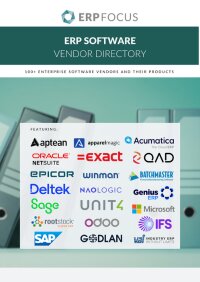
ERP Software Vendor Directory
Put the most comprehensive ERP vendor directory on your desk today
Download -
How to Select ERP
Learn to select your ERP in 5 easy steps by following our expert's advice
Download
Related articles
-

The 10 best construction ERP systems
Include these ERP systems when selecting or comparing construction ERP
-

CMMC Compliance: What Aerospace and Defense Manufacturers Need to Know
Key insights on CMMC compliance, deadlines, and securing DoD contracts with CMMC 2.0 certificatio...
-

ERP RFQ, RFI and RFP: Mastering those vendor selection acronyms
Understanding your RFP from your RFI will help you cut through the noise during an ERP selection ...