
How to evaluate your ERP RFP responses
There is confusion about the need to assess ERP RFPs before starting a selection process. Each ERP vendor offers different operational values. Without a comprehensive ERP evaluation, an enterprise may choose the wrong product for the wrong reasons at the wrong price.
Consequently, highly granular ERP evaluation criteria must be applied to ensure that all business goals are most efficiently met. These typically include:
- Clearly defined RFP evaluation criteria that allow the enterprise to compare one provider’s solution in the context of its specific operational needs, while mitigating undue sales pressure.
- The ERP evaluation approach gives the enterprise flexibility in how RFP proposals are assessed. Key focus areas include platform selection, third-party services, support responses, training, and launch or implementation processes.
- Establishing an ERP evaluation round ensures even-handed measurement when weighing the merits of competing providers.
- The application of ERP evaluation aids processes related to product sales and consequent contract negotiation.
- Developing and applying comprehensive ERP evaluation tasks provides additional data points throughout the assessment. These elements contribute to final decisions affecting pricing, implementation risk, and long-term performance validation.
What questions should I ask in an ERP RFP?
Once a proper evaluation process is complete, the best way to develop a list of vendors is to use ERP vendor selection criteria. This exercise is not redundant but marks the start of a thorough investigation into differences between providers.
There are many ways to format these criteria, from complex ERP selection matrices to simple evaluation templates. Regardless of format, the goal is to clearly define and articulate how, how much, and what each product offers compared to the company’s specific operational goals.
To help you understand what will be required, here are some general measurement concepts that can be applied to the essential selection effort:
- Begin with necessary query categories such as required platform modules like accounting, production, inventory, and distribution; depth of customer support such as direct, voice-only, online-only, or all of these; depth of warranty, price model, and similar factors.
- Include non-functional requirements in your ERP RFP, such as security standards, data migration approach, integration capabilities, reporting flexibility, scalability, and total cost of ownership.
- Develop an internal measurement method. For example, use a 1–5 metric with 5 as best, or sub-measure individual tasks. Any value process is better than none.
- Once you have a category metric structure, rank the questions within each category. For example, assign 5 points to the most needed and 1 point to the least needed.
- Weigh all major categories accordingly. For example, the most needed is worth 5 points, and the least needed is worth 1 point.
- Use the same processes and measurements relating to each individual module question.
- Re-weigh any categories/sub-categories and/or questions as necessary.
- Document assumptions behind each score to strengthen auditability and internal alignment.
Once this measurement structure is complete, the user should have a clear view of what they need to know, based on structured analysis rather than conjecture. This documented ERP assessment framework also makes it easier to justify the final vendor selection to executive stakeholders or the board.
Who should evaluate the RFP?
Who decides on an ERP system depends on the company's size, but it's usually a team or senior managers.
Ultimately, business leaders, not the IT department, should make the final call because the main priorities are how well the system fits company operations, the financial return, and the risks of implementation. If a CEO or CFO is signing off on the investment, the business's needs must come first, no matter how technically impressive a platform is.
That said, the evaluation team should include people from finance, operations, supply chain, IT, and those who will actually use the system. This ensures all key requirements are considered.
What do the statistics say?
This awareness is regularly proven by statistical metrics associated with proportional differences between successful ERP implementations versus those that fail.
Back when this article was first published, a Gartner study revealed that roughly 25% of ERP projects were delayed or canceled, and another 55% didn't meet stakeholder expectations.
These failures weren't usually due to technical issues. Instead, they stemmed from businesses struggling to understand, evaluate, and choose the right ERP platform. For instance, nearly half of the businesses found the platforms and sales offers confusing, and only about a quarter felt confident after making a purchase.
Now, Gartner predicts that by 2027, over 70% of new ERP projects won't meet their business goals, with about 25% of those expected to fail completely.
Administrative and financial managers must have time, clarity, and a structured ERP evaluation template. If enterprises ignore this, any business considering an ERP purchase will be at a disadvantage from the start.
RFP evaluation matrix
While the discussion above covers concepts and theory related to ERP RFPs, to truly understand the value proposition, you should view the effort as a practical exercise.
Let’s look at a typical ERP evaluation matrix. This example comes from a process manufacturing document focused on one page of an ERP inventory module evaluation analysis provided by Infotivity:
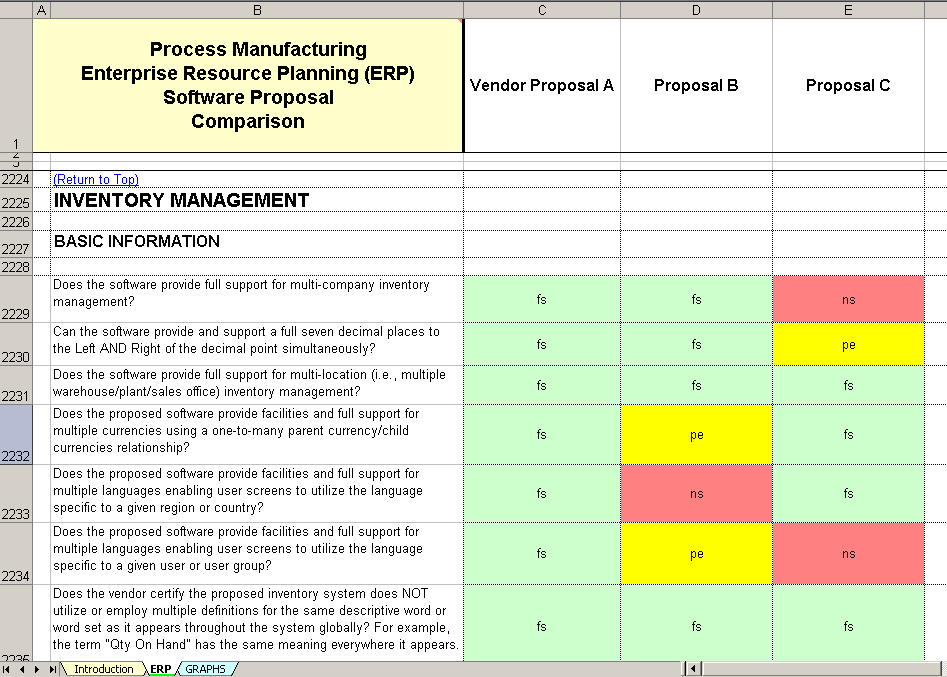
The validation legend for the aforementioned snapshot includes: fs – fully supported; pe – paid enhancement, and ns – not supported. Note that the questions suggest extended granularity, leading to further investigations and even deeper requests for information throughout the extended RFP.
Now that you’ve experienced an example of what a real evaluation matrix looks like, here are several other tips to consider:
- Write your questions as clearly as possible. If you find that a question requires a deeper investigation, add another question, but don’t utilize serial semicolons. When it comes to developing RFPs, it is expected that detailed questions will be necessary, but in execution, simple will always be the better choice.
- Narrow your selection list and stay focused on your business purpose. If your goal is to solve accounting and inventory problems, focus on those needs. Do not get distracted by extra enhancements your provider may offer. You are solving a business problem, while the salesperson is trying to sell more software. Maintain control of the evaluation process.
- Review your RFP regularly, ideally every week during the active selection cycle, to ensure you are refining your work. If you do not pay attention, scope creep can become a problem, and ERP implementations are already complex.
- As suggested earlier, using the weighted method provides a clear way to separate competing solutions. Stick to your defined ERP evaluation criteria and documented scoring model. This discipline protects both time and budget.
Things to avoid during the ERP RFP evaluation process
Now that we’ve discussed some of the major ways that you can get your ERP RFP evaluation off the ground, there are also some things you might want to avoid, including:
- Always perform a direct ERP software comparison between providers. Go through each evaluation question head-to-head to ensure nothing gets missed. When it comes to ERP assessment, time really is money.
- If a salesperson gives you a confusing answer to a question in your Request for Proposal (RFP), ask for clarification. Don't stop asking until you're satisfied with the answer. If they can't provide a clear response, it might be best to remove them from your list.
- Keep your scoring system simple. If you use a 1-5 scale for one metric, use it for all of them. Using different scoring systems can create confusion and make it harder to make a clear decision.
Final thoughts
As you might expect, there are numerous other tips and traps that you should apply when designing an ERP assessment, evaluation, and decision matrix, but as asserted earlier most are subjective. The bottom line is that any good ERP RFP is driven by patience and detail, which ultimately leads to a solid decision for the business at large.

Free white paper
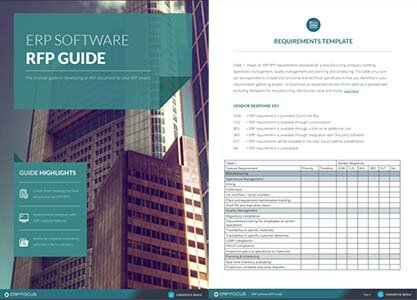
ERP Software RFP Guide & Template
The comprehensive guide to developing an RFP document for your ERP project
Featured white papers
-
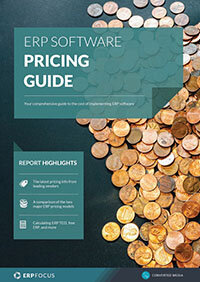
ERP Software Pricing Guide
Get the latest pricing information on over 80 popular ERP systems, and learn how to budget for your ERP project in our free guide
Download -
60-Step ERP Selection Checklist
Get the comprehensive checklist for your ERP selection project
Download -
ERP Demo Guide & Scorecard
Master your ERP demo with 5 easy steps using our free guide (includes demo scorecard)
Download
Related articles
-

The different ERP vendor tiers explained
A baseline refresher of what each ERP vendor tier means and how it will impact your selection pro...
-

CMMC Compliance: What Aerospace and Defense Manufacturers Need to Know
Key insights on CMMC compliance, deadlines, and securing DoD contracts with CMMC 2.0 certificatio...
-

3 key stakeholders for your ERP requirements analysis
Find out about the three groups of ERP users who should be considered key stakeholders during you...